
Southern Pine Timber Markets Have Changed, Your Management Planning Needs To Too

Updated: Apr 10
Little did I know, back in 1996, when I started my forestry consulting business, how good I had it. Pine timber prices were high, markets were numerous, competition among buyers was stiff, and there was an abundance of logging contractors to handle almost any job, no matter the scale. I was living on Easy Street.
What Changed?
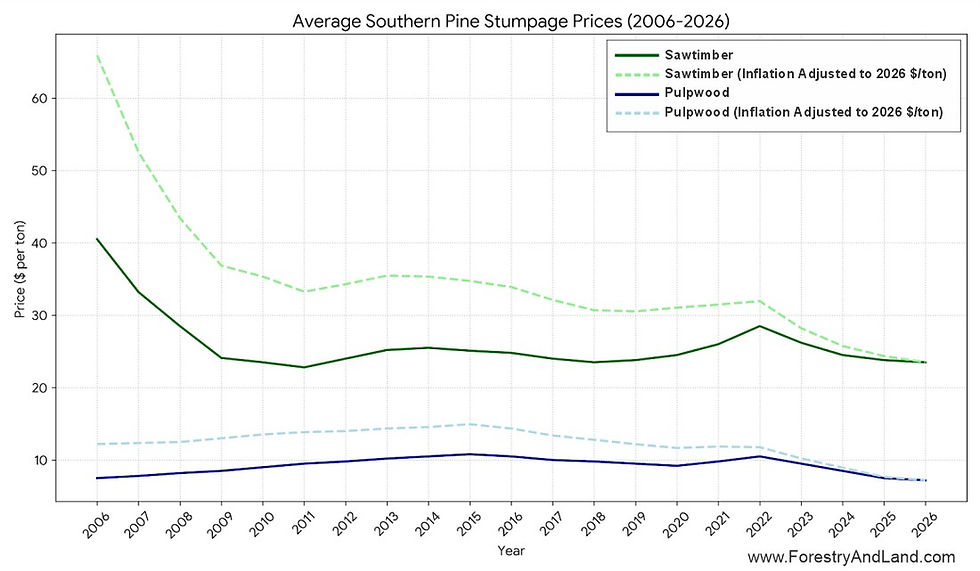
The Great Recession of 2007 was the turning point. In North Carolina, pine sawtimber prices dropped 30 to 40% within a few years. Why? The lower demand coincided with the maturation of the “Great Wall of Wood,” created by decades of government-funded tree-planting incentives that led to a glut of raw material (and yes, as you’d expect, they are still throwing fuel on the fire by funding pine planting). Additionally, some timber companies went belly up, and others consolidated, gaining more control over markets. With less competition and a glut of supply, prices had to fall, regardless of the price of lumber down at the Home Depot. Pine sawtimber prices have remained fairly stagnant since 2010, except for a slight bump during the COVID-crazed building boom. Factoring in inflation, they are declining year after year. Not only did prices fall, but specifications for sawtimber rose—the mills expect a better quality tree (even for pulpwood).
The next blow came to pulpwood markets. Over the past few years, the South has experienced a cascade of pulpwood market closings (and the satellite woodyards and chip mills that feed them), creating an additional surplus inventory problem.
Additionally, the cost of logging has gone up (equipment, insurance, trucking, labor, etc.), further eroding stumpage prices (the price of timber as it stands in the woods).
How Your Pine Management Strategy Needs to Change
Plant fewer trees per acre (TPA). Traditional planting regimes (550 to 700 TPA) assumed a thinning harvest would reduce their density midway through the rotation. Thinnings are now almost impossible to get done in some areas due to fewer loggers, lack of markets, and mill quotas. Planting at a lower density (~300 TPA) allows sawtimber products to be grown without thinning if pulpwood markets aren’t available. Additionally, low-density plantings are better for wildlife and slightly less costly.
Precommercial thin (PCT) your stands. Traditionally done in naturally regenerated stands to reduce stocking levels, you should now consider doing so in your planted stand if planted at traditional TPA levels. It is a cost, but an essential one if you ever want your trees to develop into sawtimber. PCT is typically performed when trees are 5 to 8 feet tall. Stands with larger trees will cost more to thin. Reduce levels to 250-300 TPA. Read more on PCT here.
Thin aggressively. If you can perform a mid-rotation thinning harvest (~age 13 to 18), thin a little more aggressively than traditionally. Reduce TPA to 170-190, where a second thinning won’t be necessary before a final harvest.
Natural regeneration. If you have harvested a natural hardwood or mixed stand, give it a chance to regenerate naturally. The world at present doesn’t need another pine tree.
Diversify. If you are a large-acreage owner, diversify your stand types. Putting everything in pine is like putting your whole retirement fund in one stock.
Even if you manage to grow your pines to a mature, quality, sawtimber stand, you need to be strategic when selling. Timing and sale structure can make a huge difference in the price you receive. It is common for prices offered to differ by 25% or more.
What Happens When You Don’t Thin Densely Planted Pines
They’ll grow fine for the first eight years or so, then diameter growth will slow to a crawl. Density doesn’t really impact height growth, except in extremely low densities, so height will continue to increase. The live crowns will crowd and die back, reducing the surface area of carbohydrate-producing, photosynthesizing needles, essentially putting the tree on a crash diet. As trees become increasingly stressed, they become more susceptible to insect damage. A few of the dominant trees will develop into sawtimber, but the vast majority of the stand will remain in the pulpwood category. An acre of land can only grow a finite amount of wood volume. That volume can be comprised of ~180 sawtimber trees (~$4,000 to $5,000/acre) or ~500 pulpwood trees (~$500 to $1500/acre). Total volume is the same, but the difference in total value and marketability is vast.

Growing trees is a long game. No solution for the pulpwood problem is on the immediate horizon. Even if markets come online in your area, odds are they’ll have market control due to oversupply. You need to be proactive to avoid being stuck with dense, unmarketable pine stands with no wildlife habitat. Market conditions vary widely, so it’s advisable to work with a professional who is familiar with the market outlook and contractors in your area.
Feel free to contact me with any questions or to schedule an appointment for me to view your land.


Comments